You’re More Than a Doctor: How I Reclaimed My Life After Medicine Nearly Broke Me (And How You Can Too)

No one tells you that success can start to feel like a cage.
You check all the boxes. The degrees. The accolades. The respect. You care deeply for your patients. You’ve done everything “right.”
And yet — there’s this quiet, lingering thought:
Is this really all there is?
If you’re a mid to late-career woman physician and you’ve ever found yourself asking, “Where did I go in all of this?”— or felt like your life has been on hold while you’ve poured everything into your work — you’re not alone.
I’ve been there. And I want you to know there’s more waiting for you, too!
My White Coat Was My Identity — Until It Wasn’t
I came from a small town in the middle of nowhere.
I never imagined I’d land a residency at one of the top programs in New York City — let alone go on to become co-chief resident, an associate professor at an Ivy League institution, and later the medical director of a community cancer center. I’m board-certified in radiation oncology, hold a Master of Public Health, and am a diplomate of the American College of Lifestyle Medicine.
I had worked hard and had earned it.
By every external measure, I had “made it.”
And yet, it nearly broke me.
Landing that residency was a dream come true. But during my second year, a complication after knee surgery left me temporarily paralyzed in one leg.
I expected compassion from my program. Instead, I was told “maybe I wasn’t cut out for radiation oncology”.
I proved them wrong.
I excelled, joined the same faculty, and eventually had one of the busiest clinical practices in the department.
From the outside, it looked like I had it all.
And for a while, I believed I did.
I had fully bought into the belief that academic medicine was the ultimate goal. That it was somehow more meaningful, more noble than community or private practice. I thought I wanted to publish papers and pursue research. I was proud to be one of the few – and sometimes only – Black woman in the room.
But over time, I had to admit a harder truth: I wasn’t an academic researcher at heart. I was more interested in building programs, improving quality of care, and making a tangible difference. Not chasing publications or prestige.
Still, I stayed.
Because I was afraid to leave.
Afraid to give up the security, the reputation, the status.
Afraid to walk away from the institution I had worked so hard to be a part of.
And because I truly loved my patients.
When You Can’t Show Up for the Life That Matters Most
At the time, I was the only faculty member with a young child.
Meetings were often scheduled last minute or after hours.
My infant son needed speech and occupational therapy. Some appointments were at 7am on Fridays — right when I was expected to teach residents.
I asked to adjust my schedule. My request was denied.
That moment never left me.
I was training the next generation of doctors while missing appointments that could help my own child find his voice.
And still — I stayed.
I tried to be grateful.
I poured my energy into the work no one else wanted, like Quality Assurance. I learned new skills and used it as a chance to improve systems and patient care.
That gave me purpose — for a while.
The truth was: I was making it work. But I wasn’t thriving.
When Your Body Starts Whispering — Then Yelling
Eventually, I left New York for a leadership position as Medical Director at a community cancer center. It was a dream job — part clinical, part administrative. I was excited for the next chapter — more autonomy, better pay, more opportunity to make a difference.
And I did.
We built programs. Improved outcomes. I was proud of the work we were doing.
But slowly, my life started revolving around work again. Social life, personal time, even my identity were consumed by the role. My office at home looked just like my office at work.
Then my body started speaking up.
I began having episodes of tachycardia.
My doctor at the time suspected stress, but I insisted on a cardiac stress test. I failed the exercise tolerance portion. My systolic blood pressure spiked to well over 200. I was told to start an exercise program. I didn’t. I kept going — telling myself I’d slow down “soon.”
Later, I began having neurological symptoms – tingling, weakness, pain in my arms and hands raising concerns about my future in radiation oncology. Imaging showed severely herniated discs in my cervical spine. Surgery was risky.
When I asked in an online forum whether other radiation oncologists were experiencing similar issues, the private messages said yes.
The public conversation? Silence — and even shame.
One person posted that the benefits our patients receive from radiation oncology makes up for any damage that we as physicians might endure and it’s not as though our job is “as taxing as bricklaying”.
That stayed with me.
So did the pen holder I found in an unopened box from a decade earlier — a gift from my nurses when I left New York.
It read:
“Dr. Woodhouse, time to stop living at work and start working at living.”
I had forgotten that promise until that moment.
I Wanted My Life Back – And I Decided to Take It
That was the turning point.
I realized my life revolved around my career — and my family got the leftovers. My son was a junior in high school. I had blinked, and the years had passed.
And worst of all, I didn’t even know what I wanted anymore. I had lost touch with the version of myself who once had dreams beyond medicine.
It wasn’t just the long hours or the relentless pace.
It was something deeper — something harder to name.
I had spent years navigating a system that wasn’t built for me. And along the way, I absorbed what so many women in medicine quietly endure: the microaggressions, the dismissals, the double standards. The weight of moral injury that builds when your values are at odds with the system you’re expected to serve.
I thought I was just tired. But what I was really carrying was grief.
Grief for the parts of myself I had silenced.
Grief for the years I couldn’t get back.
Grief for the woman I had almost lost in the process.
I didn’t just need rest. I needed space. I needed to heal.
I didn’t want to quit medicine. I still cared deeply about my patients. But I couldn’t give clinical practice 100% of my life anymore.
That was non-negotiable.
So I made a change.
I went part-time — three days a week as my service to my community. The other days? Those were for me. For rediscovery. For repair.
That’s when everything started to shift.
I Began Rebuilding—One Layer at a Time
I didn’t know exactly what was next, but I knew I couldn’t keep living the way I had been.
That’s when I discovered Lifestyle Medicine — and it changed how I cared for myself. I started eating better, moving more, prioritizing rest.
Slowly, the neurological symptoms eased. My energy returned. My mind began to clear.
But healing my body was only part of it.
I also began working on my mindset — what I now understand as mental fitness.
I started noticing just how often I was operating from guilt, fear, or the pressure to prove myself.
Fear of not doing enough. Not being enough.
Fear of being judged, misunderstood, or seen as less than.
Fear of being dismissed as the little woman in the room — or the little Black woman. Fear of being labeled the DEI hire.
I was constantly calculating how to be competent enough, agreeable enough, unthreatening enough — just to be taken seriously.
Guilt kept me saying yes when I was already at my limit. And no matter how much I did, it never felt like enough.
Pressure to constantly prove my worth kept me chasing unattainable perfection.
And when things went wrong — a conflict, a slight, a microaggression, a moment of disrespect — I didn’t know how to let it go.
I found myself trapped in a cycle of rumination, replaying incidents endlessly. It stole my sleep, hijacked my peace, and left me carrying stress that wasn’t even mine — always bracing for the next blow.
Learning to shift those internal patterns transformed my life — not just how I worked, but how I lived.
I reclaimed control over my responses, established boundaries to protect my energy, and rediscovered a sense of calm and clarity I hadn’t felt in years.
And then I did something I hadn’t allowed myself to do in a long time:
I gave myself permission to explore long-buried interests, to dream again — like developing the boutique villa in Jamaica that my husband and I own.
For years, I felt guilty about investing time in it — as if it wasn’t important enough, wasn’t “doctor-like” or noble enough. After all, it wasn’t curing cancer.
But I had to unlearn that belief.
I realized I had always been entrepreneurial.
I realized I didn’t have to choose between purpose and joy.
And I began to see that I could still love medicine and want something more.
And then it clicked:
Everything I had done—everything I had been through—was connected and could be translate into my next chapter..
What I had learned in medicine — building systems, leading teams, creating trust — I now used to design customized, high-touch experiences at the villa.
It was still healing work. Just in a different form.
I Reclaimed My Voice- And You Can Too
This isn’t a story about burnout. It’s about reclamation.
It’s about reclaiming the parts of yourself that you set aside to succeed in medicine — and realizing they still matter.
I’m still a doctor. But I’m also a coach, a retreat host, a business owner, a wife, a mom — a woman rediscovering her joy.
I didn’t abandon medicine. I made room for myself alongside it.
I still love advocating for my patients.
But now, I practice medicine by choice — not out of fear, guilt, or habit. This next chapter wasn’t an accident.
It was designed — with intention and clarity — to serve me, too.
Now, I help other women physicians — especially those in mid to late-career — who know there’s something more calling them, even if they can’t name it yet.
If you’ve ever felt the nudge to create something new, to rediscover who you are, or to simply stop feeling like you’re disappearing behind your title … you’re not alone.
And it’s not too late.
You don’t have to walk away from your career.
But you do have to stop disappearing behind it.
You’re not wrong for wanting more.
And you don’t have to wait to begin.
What About You?
If parts of this story felt familiar, take a moment and ask yourself:
- What dreams have I quietly set aside — because life, career, or expectations got in the way?
- What version of me have I buried under the demands of being “Doctor”?
- What would it look like to start honoring her again?
There’s no pressure to answer right now. But sometimes, the act of asking the right questions is the first step toward reclaiming yourself.
Your Turn
If my story sounds familiar, or even relatable, I want you to know:
You can want more and still be grateful.
You can build something new, without burning everything down.
You are not just allowed to dream — you’re allowed to pursue those dreams.
That’s why I created a free resource to help you reconnect with the version of you that medicine buried.
It’s not too late to become her.
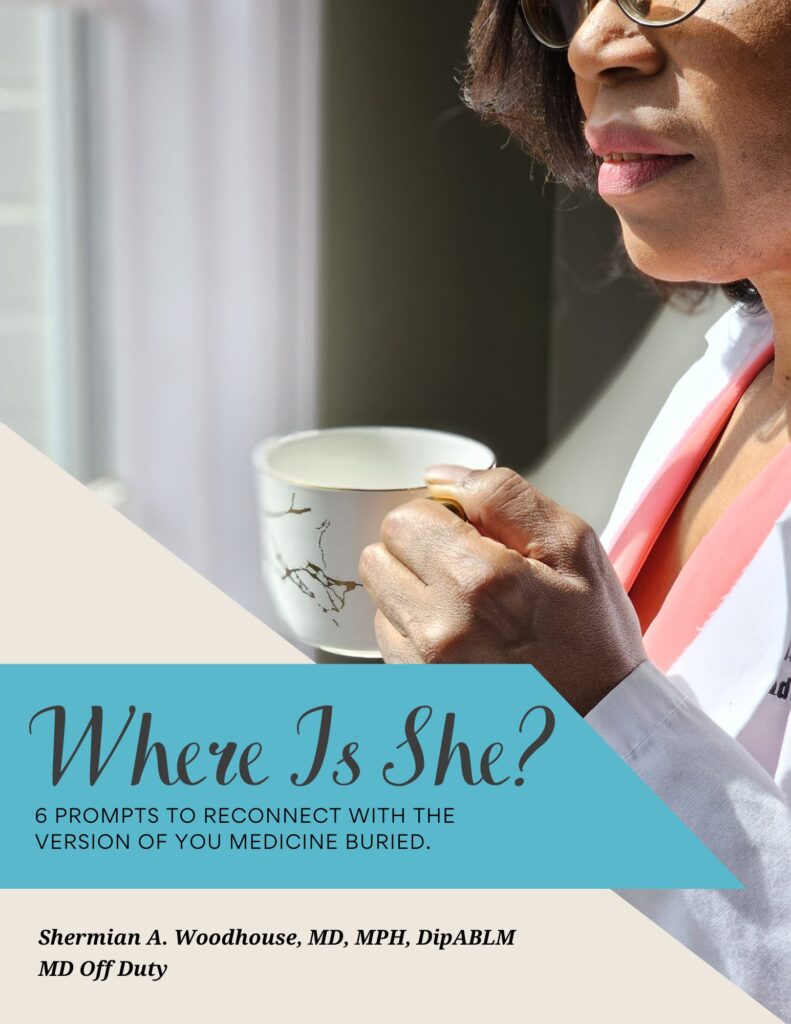
Click to download the free guide:
Where is She? 6 prompts to reconnect with a version of you medicine buried
Want to get in touch? Reach out, I would love to hear from you!
Website: https://MDOffDuty.com/contact
Instagram: https://www.instagram.com/mdoffdutyofficial
Calendly Link: https://calendly.com/mdoffduty/30min Ready to talk? Book a free discovery session with me. No pressure — just an honest conversation with someone who’s been there and is ready to help.